
There are choices we make once and never question. Loose Leaf Tea It's part of that. At Maison Taillefer, we've been preparing, selecting, and offering whole-leaf tea for decades, not out of nostalgia or purism, but because every argument supports it. The quality in the cup, the respect for the leaf, the long-term savings, the freedom of the teapot: nothing in a tea bag seriously rivals loose-leaf tea.
But loose-leaf tea can sometimes be intimidating for beginners. How do you measure it? How do you brew it? Can you really reuse it? This guide answers all these questions and should definitely convince you to make the switch.
Loose Leaf Tea vs. Tea Bags: What Really Changes in the Cup
The difference begins well before the infusion. It begins with the leaf itself.
The quality of the sheet
A tea bag contains what the tea industry calls fannings or dusts : THE residues from tea production, The finest particles, the broken pieces, sometimes stems. These fragments have maximum surface area in contact with the water, which accelerates extraction. But it primarily extracts tannins, responsible for bitterness and astringency, at the expense of delicate aromas and flavor nuances.
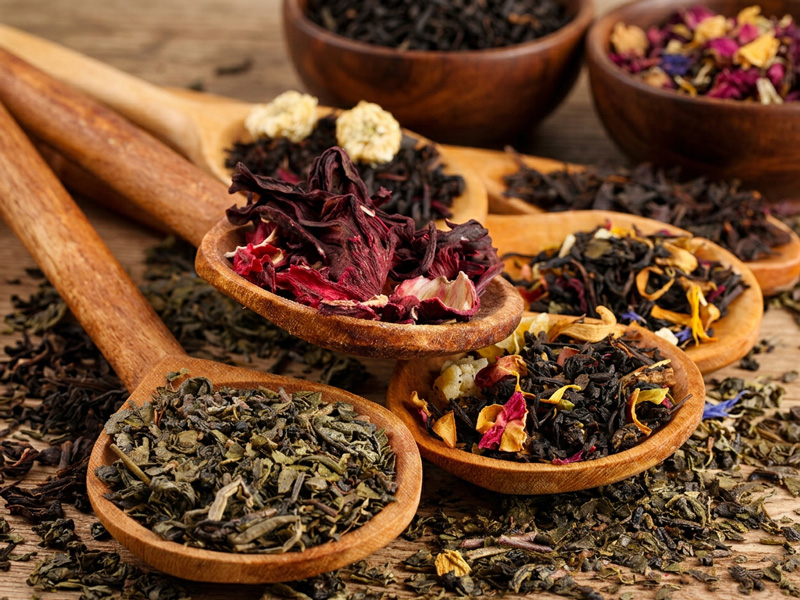
Loose-leaf tea, on the other hand, uses whole leaves Or slightly broken, harvested and processed with care. These leaves need space to open, unfurl, and gradually release their aromas. It is this opening, what we call the agony of the leaves in the world of tea, which gives a well-rounded, complex and balanced cup.
In short: tea bags are designed for speed. Loose leaf tea is designed to be good.
The aromas have been preserved.
The whole leaf is a natural treasure. As long as it remains uninfused, it retains its essential oils, aromatic compounds, and antioxidants within an intact cellular structure. The tea bag, with its leaves ground into a fine powder, exposes a maximum surface area to air, which accelerates oxidation and aromatic degradation from the moment of production.
A quality loose-leaf tea, properly stored in an airtight container away from light, retains all its aromatic vibrancy for months. A tea bag, even individually wrapped, cannot say the same.
The freedom of dosage
With loose leaf tea, you control exactly what you put in the teapot or filter. Light cup or strong tea, large teapot for several people or small individual cup: it's that simple.’adjust the quantity of leaves. The tea bag, however, is calibrated for a single standard cup. It's impossible to easily adapt it without opening a second one.
Loose leaf tea is more economical than it seems
This is the argument that surprises new converts the most. At first glance, a box of loose-leaf tea may seem more expensive than a pack of tea bags. But in the long run, the math is undeniable.
Cost per cup
A standard tea bag contains approximately 2g of tea and makes one cup. Therefore, 100g of tea bags will make 50 cups.
With 100g of loose leaf tea, using 2.5g per cup (about a heaped teaspoon), you can already prepare 40 cups. But this is where the decisive factor comes in: the second infusion.
The magic of the second (and third) infusion
THE Loose leaf tea can be brewed several times. The whole leaves, after the first infusion, still have much to offer. The second infusion often yields a softer cup, more subtle, sometimes more interesting than the first. Some Japanese green teas like Gyokuro or Taiwanese oolongs reveal their best notes on the third or fourth infusion.
In practice, expect 2 to 3 infusions per dose of loose leaf tea. Your 100g of leaves no longer prepares 40 cups, but 80 to 120 cups. The cost per cup then drops well below that of a tea bag, for incomparable quality.
Simple rule: one dose of loose leaf tea = 1 cold infusion or 2 to 3 hot infusions.
Loose leaf tea, ideal for preparing a teapot
Perhaps this is where the practical advantage is most obvious. The teapot and loose-leaf tea are made for each other.
For several cups, it's simpler
Preparing a pot of tea with tea bags involves stacking 3, 4, or 5 bags in hot water. This makes it difficult to measure the right amount, difficult to remove at the right time, and often results in an uneven brew depending on the placement of the bags. With loose-leaf tea, you simply put the leaves directly into the teapot (with a built-in strainer) or into a tea infuser and adjust the quantity to the volume of water. The result: a consistent, perfectly measured pot of tea, ready for everyone at the table.
The gesture is simple
Contrary to popular belief, preparing loose-leaf tea is no more complicated than using a tea bag. You need to:
- Heat the water to the right temperature depending on the type of tea (100°C for black tea, 70-80°C for green tea, 60-75°C for white tea)
- Measure the leaves approximately 2 to 3g per cup (one teaspoon)
- Infuse for the indicated time 3 to 5 minutes for black tea, 1 to 3 minutes for green tea, 4 to 8 minutes for white tea
- Remove the leaves before serving to stop extraction.
- Keep the damp leaves in the teapot for a second infusion
That's it. Five steps, less than two active minutes. And a infinitely better cup of coffee.
Accessories that make life easier
To fully enjoy loose leaf tea without any hassle, a few simple accessories are all you need:
- THE stainless steel tea filter is the most versatile tool: it fits any cup or teapot, rinses easily and retains no aroma.
- There teapot with integrated strainer This is the most elegant option for preparing several cups at once. Ceramic or cast iron teapots retain heat well and allow for a second infusion directly in the pot.
- There tea ball It's practical for individual cups, but be aware: it's often too small for large-leaf teas that need room to unfurl. Opt for a larger filter instead.
How to properly store loose leaf tea?
Loose leaf tea that is not stored properly quickly loses its aromatic qualities. Four enemies to know : light, humidity, heat and surrounding odors.
- Store your tea in a opaque airtight box, preferably made of metal or ceramic with a seal
- Avoid the cupboard above the stove: the heat and steam are harmful.
- Don't store your tea next to your coffee, spices or other fragrant products: tea leaves are very absorbent
- Avoid the refrigerator Successive condensations degrade the tea quickly
A well-preserved loose leaf tea retains all its qualities for 6 to 24 months depending on the variety, or even longer for aged teas like some Pu-erh.
Taillefer Loose Leaf Teas: the selection that makes all the difference
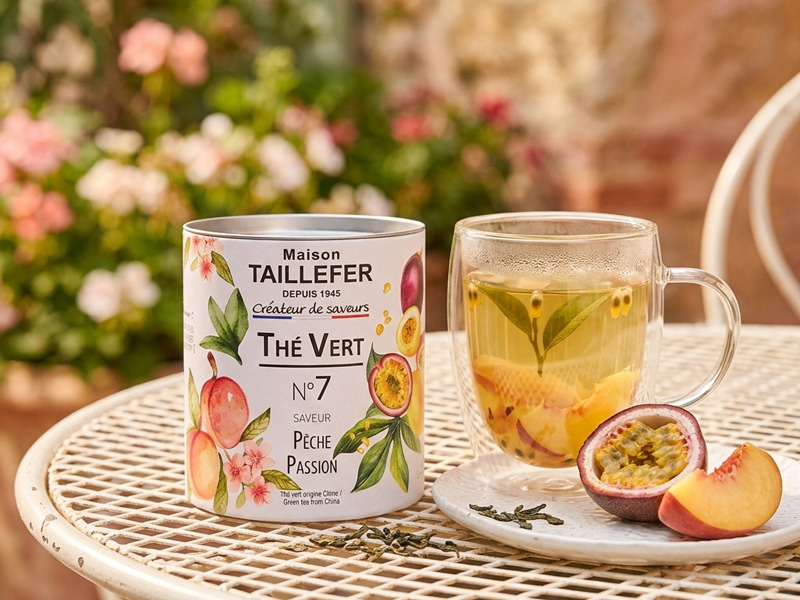
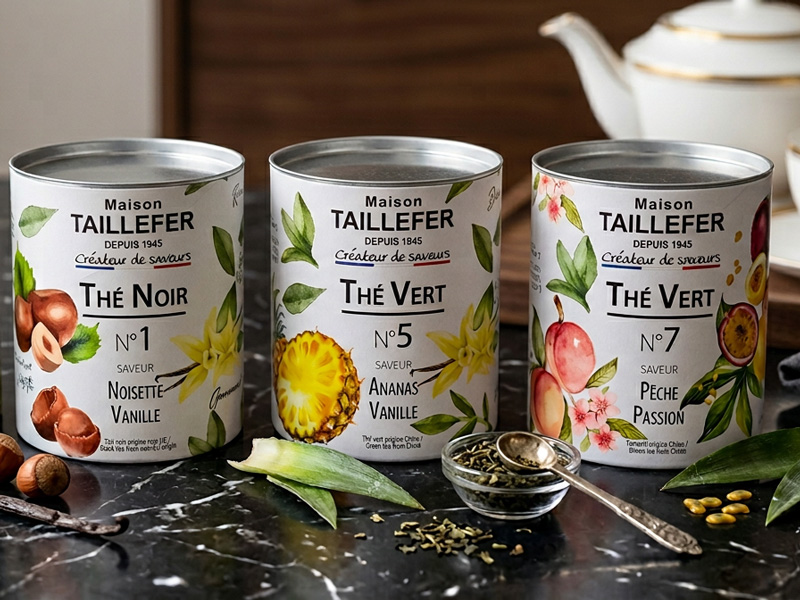
At Maison Taillefer, loose-leaf tea is a long-standing commitment. Each variety is selected for the quality of its leaves, the clarity of its origins, and the richness of its aromatic profile. Discover our selection of loose-leaf teas on our website and at our retailers in garden centers and gourmet food shops, in formats suited to all uses.
In summary
Loose leaf tea is the entire sheet, THE aromas preserved, The deep cup, the easy-to-use teapot, and long-term savings. It also offers the possibility of...’infuse two or three times the same dose, an advantage that tea bags simply cannot offer. Once you've switched to bulk, you don't go back.